Why a rack?
The HP ProCurve 1810G-24 was a gift from an acquaintance. That immediately created the obvious technical requirement: now there had to be a rack. The current cabinet is 10U.
10U RACK · SMALL SERVERS · USEFUL WEIRDNESS
Private infrastructure behind the desktop
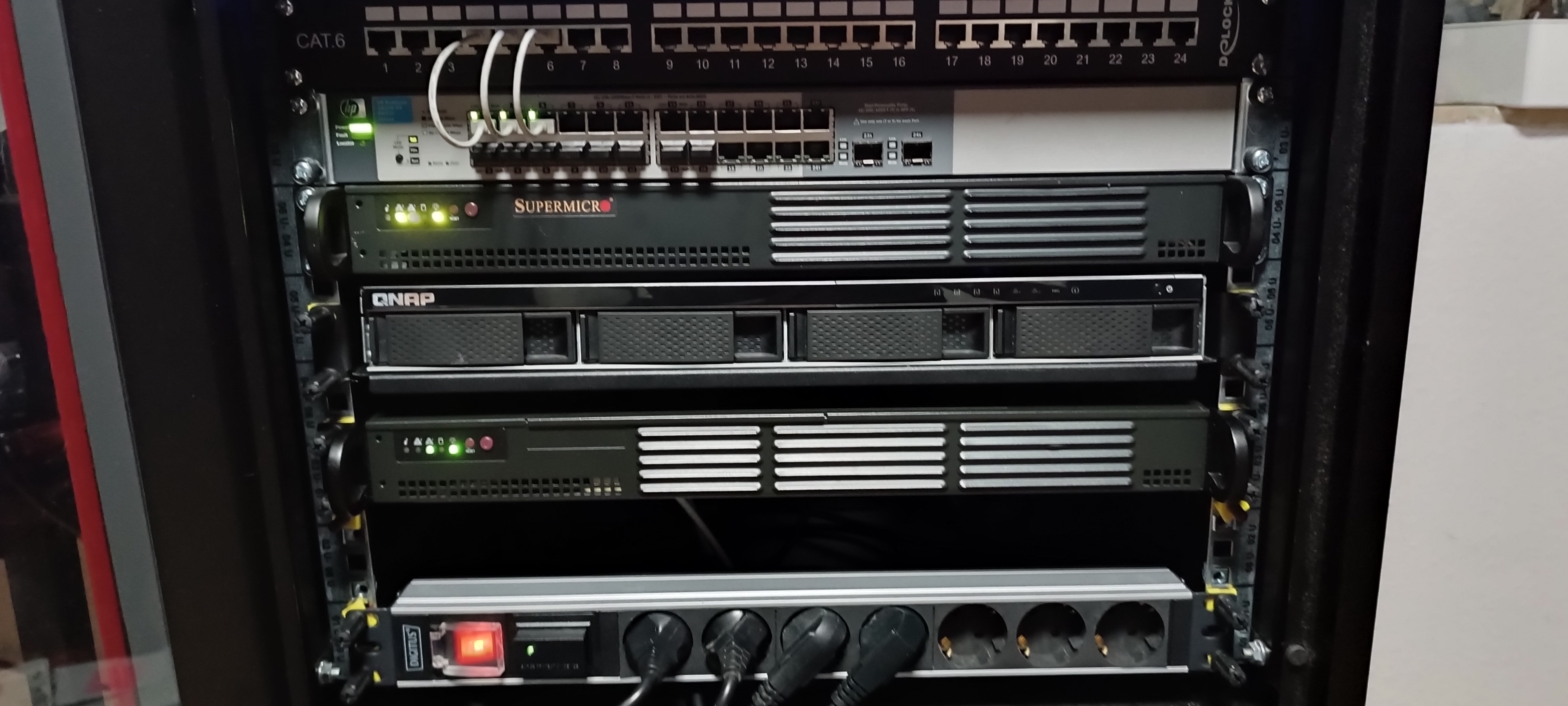
The HP ProCurve 1810G-24 was a gift from an acquaintance. That immediately created the obvious technical requirement: now there had to be a rack. The current cabinet is 10U.
Two intake fans at the rear/bottom and two exhaust fans at the top, behind coarse grills that are cleaned by hand. Top exhaust is useful when cats exist in the same universe.
An APC Smart-UPS SMT2200RMI2UC sits at the bottom. It protects the rack and Starlink hardware, not Cthulhu and not the UniFi PoE injectors.
THE FOUR SUPERMICROS
Supermicro CSE-502 / X7SPE-HF. WAN in, one LAN/uplink out. It provides routing, VLANs, DHCP, firewall and Unbound DNS with encrypted forwarding to Quad9.
No Suricata IDS/IPS by choice: strict segmentation and a small DNS blocklist are useful here; noisy inspection and TLS interception are not.
The original Worldnode still lives. Today it handles Starlink measurements, World Observer helper feeds, the private OSCAR/ICQ service, WRP, Jellyfin, apcupsd, LocalSend receiving and an on-demand UniFi Controller.
SSH uses keys only. IPMI exists, but the cable normally does not.
A small backup/helper node with a direct 40G link to Cthulhu. It exists because the old hardware is quiet, reliable and already paid for.
Supermicro X11SSL-F in a shallow 1U case. Two 1 TB WD Blue SSDs mirror the system; three more 1 TB drives form a disposable lab pool.
TempleOS, Windows 98, Solaris, Hyprland update tests — nothing here is production. If it explodes, that was probably the point.
The goal is not maximum runtime. In an outage, unnecessary systems are shut down quickly. If the HP backup server is actively copying important data, QNAP stays up long enough to remain its source while the rest of the rack sheds load.
This has been tested with the breaker deliberately switched off during a backup. QNAP and the HP MicroServer finished cleanly, and the UPS still had nearly 20 minutes of runtime left. When mains power returned, the rack recovered automatically; QNAP took its usual few minutes and announced its return with the traditional little beep melody.
No central Grafana wallboard, no always-on UniFi Controller, no Tailscale and no remote VPN into the house. They were either tested and removed or never justified by the use case. The lab is allowed to be boring when boring is the better design.